
Kochuten, “Paradise in a Jar,” is the Dairakudakan company’s own studio, where they have been producing shows since 2001. With a capacity of 60 spectators, the hall was packed; the round cushions placed on the benches had been pushed together as much as possible to accommodate everyone, with the cheerful support and urging of the troupe members responsible for welcoming guests.
1/ Planet Solaris
As the curtain rises, we are faced with a vertical stage: scaffolding protrudes from a dark partition, and 5 dancers are fixed to the wall, hindered by the iron bars. This first tableau, very impressive, consists of a vertical choreography where the dancers, all painted white, manage to free themselves, moving together, in rhythm. Coordination of gestures, sequence of movements, abdominal work, footwork. As the characters return to their places after various migrations, an orb appears. A disco ball, the middle dancer seizes it, then the characters disappear to the right side where an opening is hidden.
2/ Summoning the Unknown X
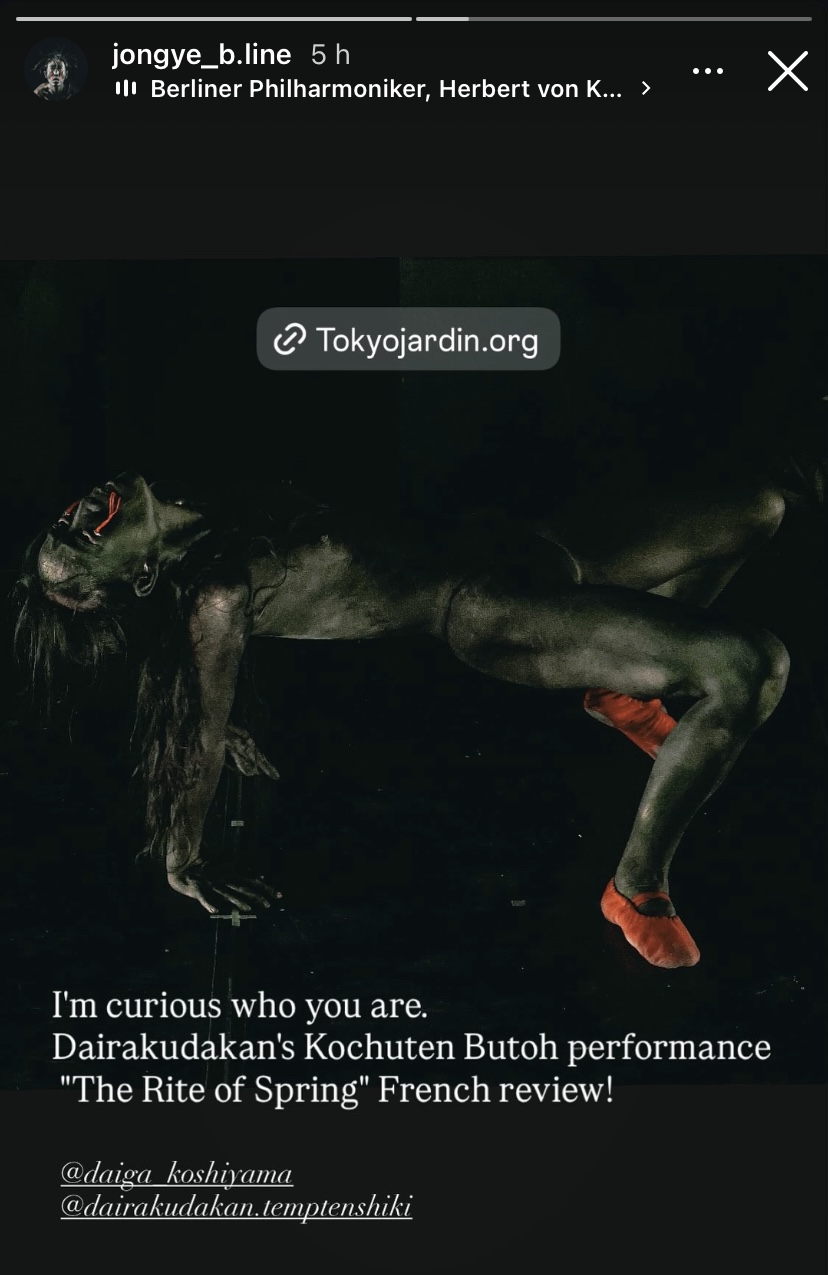
The orb has rolled to the middle of the stage. A dancer emerges, moving in an inverted four-legged crawl, on her back, a subtly grotesque movement, a suspended reptation. The orb slips between her legs, and her back rubs against the orb, carrying it in rotation as she moves. In the air, on the scaffolding, a shadow appears, entirely plastered in black, with a minimalist fundoshi as her only clothing, except for red shoes, red like the eyelash/thread/tear ornament glued under her gaze. One has the impression of seeing Christ weeping tears of blood, or rather one of those Black Madonnas from medieval Auvergne or Italy. The shadow moves, holding a radio that emits an indistinct rustling, the set doesn’t pick up a signal; sometimes a phrase escapes, not as distinctly as in Cocteau’s Orpheus.
3. To Mom
Three dancers, still in white, arrive from the right, wearing blue skirts and straw hats. No dance, just wandering, they take possession of the stage. To the sound of brief yelps, they dance and wander. A stag arrives, a stag’s skull, a head composed in the style of Arcimboldo, made of fabric, paper, and dried vegetation. The stag drags itself onto the stage, a dancer painted in white. The stag wears a panty that looks moldy, like an animal skin found at the bottom of an attic. The stag’s eye is red, a red dot protrudes from its foot. A dancer arrives with a pierced bucket, knocks it over, it’s holed, it absorbs her head, her arm passing through it forms the antlers of the stag.
The radio makes an appearance, a struggle ensues to retrieve it. The shadow is the object of pursuit by the other characters; the assembled bodies evoke Arcimboldo’s paintings.
4. Still Life
Seated on the scaffolding, two dancers on the right and left sides each hold a book. They read passages from them, alternately in Japanese and English. Golden marbling has appeared on the bodies of the white characters.
Suddenly, like Shiva, or the thousand-armed Kannon of Sanjusangendo, the shadow appears, hidden under fans. Squeals. The other dancers grab the fans with their mouths, which take the place of their faces. A golden face, a red face, the accessories modify the chromatic balance of the stage and the meaning of the dance.
5. The Rite of Spring
To a remixed Requiem, the shadow arrives, but this shadow has stepped into the light. Naked except for the fundoshi and her framing hair, she is now golden, holding the orb. The dancers in a trance form a circle around her, sweat continues to drip, streaming over and with the makeup on their skin. They will not sacrifice her, but worship her.
Before “The Rite of Spring,” Jongye YANG choreographed “Youyayouya” with the Dairakudakan company in 2013. Born in Busan, a dance graduate of Korea’s Kyungsung University, she joined Akaji Maro in 2009. At almost 50 years old, with this new work, she achieves a great performance, both physical and artistic. Despite a narrative thread that is not always obvious, but which can also be its strength, one is held spellbound throughout the 75 minutes of the show, captivated by the actors’ wall performance, by the obscure shadow dancing at the center of the work, and by the energy emanating from her choreography. A few splashes of color, red, sometimes gold, guide us through the tableaux, tracing landmarks. The show concluded with sustained applause and many curtain calls from the audience, demonstrating general enthusiasm, from amateurs as well as a Lithuanian troupe who came to attend the performance.
For original version, and more details
 Tokyo stages and live arts, theatre and biodiversity